

A love story written in scales: new salamander species in China honors a six‑decade scientific partnership
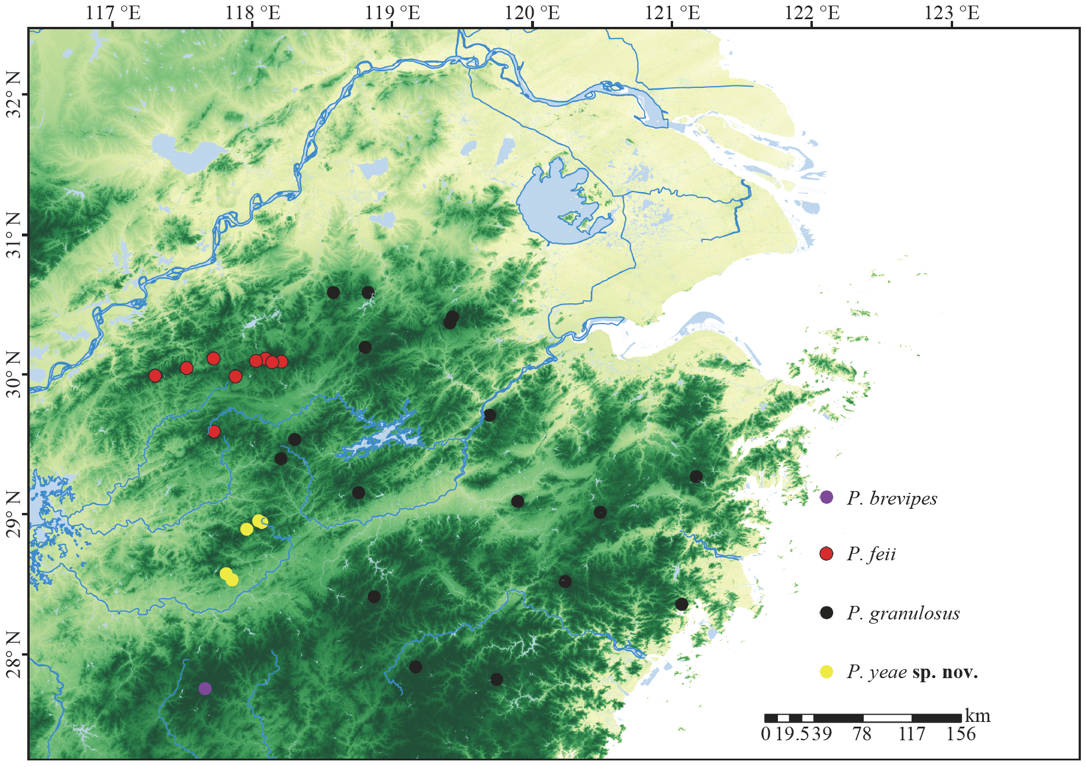
Distribution map of Pachytriton species in eastern China. Colors of each circle refer to different species.
GA, UNITED STATES, July 20, 2026 /EINPresswire.com/ -- In the misty Huaiyu Mountains of eastern China, scientists have discovered a new salamander species—and its name carries a story as remarkable as the find itself. The discovery adds an eleventh member to the genus Pachytriton and confirms that the biodiversity of China’s subtropical mountains has been significantly underestimated. Through detailed morphological measurements and phylogenetic analyses of two mitochondrial genes (Cyb and ND2) and the nuclear gene RAG1 (Recombination activating gene 1), researchers identified the newt as a distinct evolutionary lineage. The findings raise urgent questions about how many more hidden species may be disappearing from these rapidly changing landscapes.
For decades, the stout newts of the genus Pachytriton—salamanders native to eastern and southern China—were thought to comprise only a handful of species. But as molecular tools have advanced, what once appeared as widespread populations have increasingly revealed themselves as complexes of cryptic species, each with unique evolutionary histories. The genus has grown from two recognized species to ten in recent years, yet many lineages remain poorly understood. Meanwhile, the small montane streams these amphibians call home face mounting threats from deforestation, hydropower development, and tourism-related disturbance. Based on these challenges, there is an urgent need for in‑depth research into the distribution, evolutionary relationships, and conservation status of these poorly documented amphibians before they disappear.
Now, a team of researchers from Anhui University, Bengbu University, the Jiangxi Wuyuan Forest Bird National Nature Reserve, Cardiff University, and the Chengdu Institute of Biology of the Chinese Academy of Sciences has described (DOI: 10.3724/ahr.2095-0357.2025.0060) the new species in Asian Herpetological Research (Volume 17, Issue 2, 2026). Named Pachytriton yeae sp. nov.—or Ye's Stout Newt—the amphibian was discovered during field surveys in the Huangshan‑Huaiyu Mountains Biodiversity Conservation Priority Area from April to May 2025.
The research team, led by Caiwen Zhang and Shihang Xu, collected 41 individuals and analyzed both mitochondrial genes (Cyb and ND2) and the nuclear gene RAG1 to reconstruct the species' evolutionary relationships. Phylogenetic analyses placed the new species as the sister lineage to Pachytriton feii, a species described in 2011. Genetic divergence between the two was substantial: uncorrected *p*‑distances reached 5.5% for Cyb and 7.1% for ND2—well above the generally recognized species‑level threshold for amphibians. Morphologically, the new species can be distinguished from its closest relative by a suite of traits: a distinctive silver horizontal stripe along the tail (absent in P. feii), larger head width and length, broader chest, and greater tail height in both sexes. Males also have longer forelimbs and a wider internasal distance, while females possess longer tails. These differences, the researchers argue, reflect adaptive divergence driven by distinct microhabitats across the Huangshan and Huaiyu mountain systems—two ranges that differ fundamentally in granite type, tectonic history, and erosion processes.
“The new species is phylogenetically the sister taxon to Pachytriton feii—a congener named for the late Professor Liang Fei,” the authors said. “Naming this new species after Professor Changyuan Ye, Professor Fei's long‑time research partner and spouse, reflects their enduring collaborative contributions to Chinese herpetology over more than six decades. The sister relationship between the two salamander species mirrors the profound personal and professional bond they shared—it's a tribute that immortalizes their intertwined legacy in the very taxa they studied. As Professor Ye continues their unfinished work alone, this new species stands as a living reminder of how their love and science were fused.”
The discovery has immediate conservation implications. Pachytriton yeae is known from only four sites in the Huaiyu Mountains of northeastern Jiangxi Province, where it inhabits small montane streams at elevations of 600 to 1,000 metres. These streams face growing threats from deforestation, small hydropower projects, and tourism‑related disturbance. The species co‑occurs with several endemic amphibians—including Boulenophrys boettgeri, Amolops wuyiensis, and Odorrana tianmuii—forming a unique montane aquatic community that highlights the Huaiyu Mountains as a conservation priority. Protecting this habitat would benefit multiple threatened taxa simultaneously. The researchers note that future work should expand field surveys across the Huaiyu and adjacent Baiji Mountains, refine evolutionary relationships with more comprehensive genetic datasets, and investigate the adaptive significance of the species' distinctive traits through behavioural and ecological studies.
DOI
10.3724/ahr.2095-0357.2025.0060
Original Source URL
https://doi.org/10.3724/ahr.2095-0357.2025.0060
Funding information
The work was supported by the National Key R&D Program of China (2023YFF1304905) and the China Biodiversity Observation Networks (Sino BON - Amphibian and Reptile).
Lucy Wang
BioDesign Research
email us here
Legal Disclaimer:
EIN Presswire provides this news content "as is" without warranty of any kind. We do not accept any responsibility or liability for the accuracy, content, images, videos, licenses, completeness, legality, or reliability of the information contained in this article. If you have any complaints or copyright issues related to this article, kindly contact the author above.
